
The scheduler pulls new and updated Salesforce records into Jira on a five-minute cadence.
Documentation validated against bridge build on May 19, 2026
Technical deployment guide for the Salesforce Bridge for Jira
This guide covers Marketplace installation, Salesforce OAuth client credentials setup, Smart Connected Items, custom per-field sync ownership, Conditional Sync Rules, associated Salesforce record display, five-minute scheduled reconciliation, Jira push events, and the linked-record workflow inside the Jira issue panel.
Marketplace app
Forge app
Jira admin page
Jira issue panel
Salesforce REST API
Custom per-field sync
Issue, comment, and attachment events push eligible Jira changes back to Salesforce.
Files above 10 MB are skipped so sync stays within Forge runtime and payload limits.
Common standard objects are curated and custom objects are discovered from Salesforce describe metadata.
Fast Path
Quick start in seven steps
Install the app
A Jira site admin installs the Salesforce Bridge for Jira and opens the app from Jira administration.
Use the right Salesforce org
For predictable setup, use a Salesforce Developer Edition org or another org that exposes External Client Apps and API access.
Create a dedicated integration user
Choose the Salesforce user that the app will run as. That user needs API access plus read and update rights on the objects you plan to sync.
Create the External Client App
Create a Salesforce External Client App for the OAuth 2.0 client credentials flow, enable Client Credentials Flow, and assign the Run As user.
Copy the Login URL, Client ID, and Client Secret
Use a Salesforce login URL that matches your org policy, then paste the Client ID and Client Secret into the Jira admin page.
Create Smart Connected Items
Choose display-only, one-way sync, two-way sync, or custom per-mapping behavior, then configure Jira scope, Salesforce object, field mappings, Conditional Sync Rules, associated records, and optional sync features.
Link or auto-create records
Jira users can manually link Salesforce records from the issue panel, and synchronized Smart Connected Items can optionally auto-create Jira issues from new Salesforce records. When associated records are enabled, users can also review related Salesforce context without leaving the Jira issue.
Architecture
How the bridge works
Current sync model in this build
The scheduled trigger runs every five minutes. It can create Jira issues for new Salesforce records when auto-create is enabled, evaluates Conditional Sync Rules, and applies eligible Salesforce-to-Jira updates for mapped fields, status, comments, and attachments on linked records.
Jira-to-Salesforce updates are event-driven. Jira issue updates push field and status changes according to the selected sync mode or the field owner selected for each custom mapping. Jira comment events push Jira comments, and Jira attachment events push new Jira files to Salesforce without waiting for the next scheduled run.
Where configuration and state live
- Salesforce connection settings are stored in Forge app storage.
- The OAuth client secret is stored in Forge secret storage.
- OAuth access tokens are requested dynamically and cached for the current invocation.
- Smart Connected Item definitions and issue-to-record links are stored in Forge app storage.
- Comment and attachment pairing state is stored per linked issue and record pair.
- Production usage is license-gated, while development installs can still be tested.
How Jira users see the integration
- The issue panel shows one card per Smart Connected Item that applies to the Jira project.
- Display-only items wait for a manual link before showing selected Salesforce fields.
- Synchronized items can be manually linked or auto-managed by the scheduler.
- Linked records can expose field previews, a direct Salesforce link, refresh, and unlink actions.
- Associated Salesforce records can appear as read-only expandable groups below the primary linked record.
- Auto-managed links stay read-only in the issue panel but can still be refreshed.
Object Catalog
Supported Salesforce objects in this bridge
| Module / object group | Objects in the current curated catalog | Typical use | Notes |
|---|---|---|---|
| Salesforce Service Cloud | Case |
Service, support, and incident-style workflows | Best fit for full sync, comments, attachments, and status behavior. |
| Salesforce CRM | Account, Contact, Lead, Opportunity |
CRM visibility, manual links, and object-specific field previews | Leads and Opportunities can also participate in synchronized flows when the selected mappings make sense. |
| Salesforce Activities | Task, Event |
Activity-oriented records that Jira teams need to reference or sync | Status-like behavior depends on the chosen Salesforce field such as Status or ShowAs. |
| Salesforce Revenue | Quote, Order, Contract |
Commercial and downstream operational tracking | Useful when Jira teams need visibility or controlled one-way / two-way synchronization on revenue records. |
| Custom objects | Live custom object catalog returned by Salesforce describe metadata | Org-specific data models | Custom objects are surfaced dynamically so the admin can work against the connected org instead of a hardcoded list. |
Field pickers are live
The admin field selectors are built from live Salesforce describe metadata. Generic field
labels such as Name are expanded when needed so admins can read options like
Account Name more clearly in the picker.
Terminology
Key terms used by this bridge
Smart Connected Item
A saved bridge configuration that defines the Jira scope, Salesforce object, selected fields, mappings, and sync behavior.
Display-only Item
A manual-link-only item that displays selected Salesforce fields in the Jira issue panel without turning on synchronization.
Connected Project
The synchronized form of a Smart Connected Item. It targets one Jira project and one Jira issue type, and it can auto-create Jira issues from Salesforce records.
Custom Sync per Mapping
A synchronized Smart Connected Item mode where each mapped field has its own owner: Salesforce owns, JSM owns, or both own. This lets one item combine Salesforce-to-Jira, Jira-to-Salesforce, and two-way field behavior in the same mapping set.
Conditional Sync Rule
An optional rule that evaluates one Salesforce field before synchronization and moves the linked Jira issue to one configured status when the condition is met and another configured status when it is not met. When auto-create is enabled, the admin can also decide whether non-matching new Salesforce records should create Jira issues.
Associated Salesforce Records
Read-only related-record groups shown in the issue panel for context. They help Jira users see related Salesforce records without changing the primary linked record or creating additional Jira links.
Auto-managed Link
A record link created by the five-minute scheduler. It is intentionally read-only in the issue panel so users do not break the scheduler-owned relationship by hand.
Integration User
The Salesforce user selected as the Run As user in the External Client App. The bridge performs API operations with that user's access.
Refresh
A manual issue-panel action that immediately pulls the latest Salesforce fields, comments, and attachments into Jira for the linked record.
Atlassian Marketplace
Install from Atlassian Marketplace
Who installs the app
A Jira site admin installs the Salesforce Bridge for Jira and then opens the app from Jira admin settings > Apps.
- Install the published Marketplace listing into the target Jira Cloud site.
- Open the app from the left-side apps list in Jira administration.
- Confirm the app is connected before you create any Smart Connected Items.
What the admin page becomes
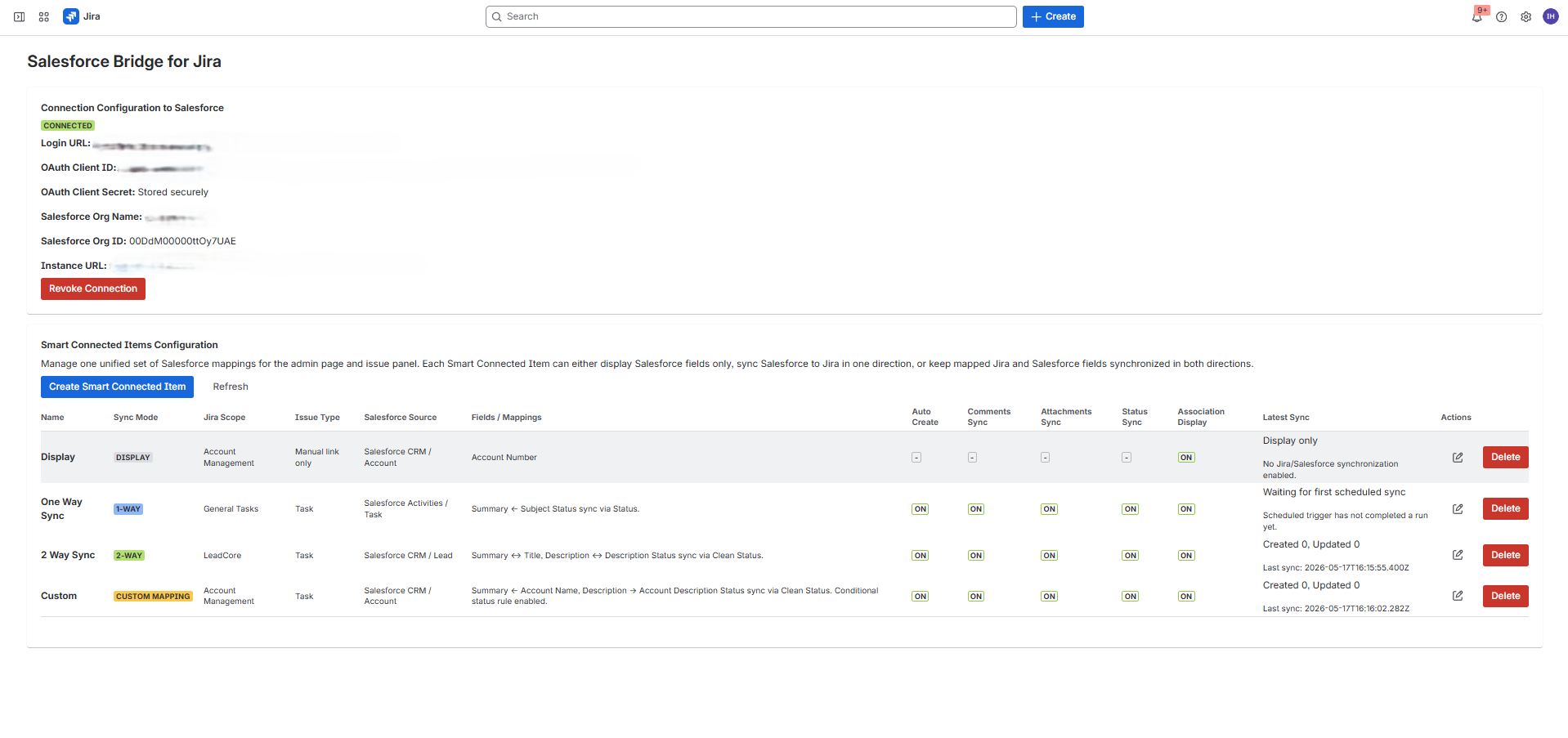
Once installed, the Jira admin page becomes the operating surface for the Salesforce connection, the Smart Connected Items table, and the latest sync state for each synchronized row.
- Connection summary: Login URL, Client ID, Org Name, Org ID, Instance URL.
- Smart Connected Items dashboard: mode, Jira scope, Salesforce source, mappings, and latest sync.
- Row actions: edit, delete, and manual refresh of the configuration list.
Salesforce Org Prep
Get a Salesforce org that supports the setup flow
If the New External Client App button shows Page not found
That usually points to org edition, feature availability, or Salesforce admin permission limits rather than a Jira-side problem. For testing, use a Salesforce Developer Edition or another org where External Client Apps are available.
Recommended org type
Use a Salesforce Developer Edition org for product validation, screenshots, and repeatable API testing. It is the cleanest environment for bridge setup.
Required Salesforce admin capability
You need access to Setup plus permission to manage apps, integration users, and object security for the records the bridge will read or update.
Integration user recommendation
Use a dedicated Salesforce user for the bridge instead of a personal admin account. That keeps audit trails and permissions predictable.
Login URL options
The Jira app accepts https://login.salesforce.com,
https://test.salesforce.com, or a My Domain URL such as
https://your-org.my.salesforce.com.
No callback URL is required
This bridge uses the OAuth 2.0 client credentials flow. Because the app is not doing a browser redirect authorization step, you do not need to configure a callback URL for this integration.
Salesforce Setup
Create the Salesforce External Client App step by step
Authentication model used by this app
The Salesforce Bridge for Jira uses Salesforce OAuth 2.0 client credentials. In current Salesforce orgs this is normally handled by an External Client App. If your org still uses the older Connected App model for server-to-server integrations, the same Jira fields can work there too: Login URL, Client ID, and Client Secret.
Open Setup
Sign in to Salesforce as an administrator, click the gear icon, and open Setup.
Open App Manager
In Setup, search for App Manager. From there, click New External Client App. If your org exposes the dedicated External Client Apps area instead, you can also navigate through Apps > External Client Apps > External Client App Manager.
Create the app record
Enter a clear name such as Jira_Salesforce_Bridge, add the contact email, keep the app private to the org unless you have a stronger reason, and save the app.
Create or confirm the integration user
Decide which Salesforce user the bridge should act as. That user should have API access and the exact object, field, comment, and file permissions needed for the records you want Jira to link or sync.
Open the Policies tab
In the External Client App manager, open the created app and then open the Policies tab. This is where the client credentials flow is enabled.
Enable Client Credentials Flow
In the OAuth area, enable Client Credentials Flow and set the Run As user to the integration user you prepared.
Keep scopes minimal
Authorize only the Salesforce API scope the bridge needs:
Manage user data via APIs (api). Do not add unrelated OAuth scopes.
Copy the Client ID and Client Secret
Save the app, reveal the generated credentials, then copy the Client ID and Client Secret. You will paste them into the Jira admin page.
Recommended Salesforce-side access for the Run As user
- API Enabled on the user profile or permission set.
- Read access to object metadata so the bridge can load field catalogs.
- Read and update access on the Salesforce objects you plan to synchronize.
- Comment and feed access for
CaseComment,FeedItem, andFeedCommentwhere applicable. - File access for
ContentVersion,ContentDocument, andContentDocumentLink.
Values you will enter into Jira
- Salesforce Login URL: login, test, or your My Domain base URL.
- OAuth Client ID: the value generated by the External Client App.
- OAuth Client Secret: the matching secret for that client.
The Jira admin page validates the credentials immediately by requesting a Salesforce access token and confirming the connected org and instance URL.
Minimal OAuth scope for this bridge
Manage user data via APIs (api)Common setup mistakes that cause validation errors
- No client credentials user enabled: Client Credentials Flow is not enabled or no Run As user is selected.
- Too many scopes requested: the app is configured with extra OAuth scopes beyond the minimal API scope.
- Scope parameter not supported: some orgs reject the optional scope parameter unless the External Client App itself is already configured with the minimal API scope.
Jira Admin
Authenticate in the Jira admin page
Connection form fields
- Salesforce Login URL: for example
https://login.salesforce.comor your My Domain URL. - OAuth Client ID: copied from Salesforce.
- OAuth Client Secret: copied from Salesforce.
Connected-state summary
- Connected status lozenge.
- Stored Login URL and OAuth Client ID.
- Salesforce Org Name and Org ID returned by validation.
- Salesforce Instance URL resolved from the token response.
- Revoke Connection button to clear the saved configuration.
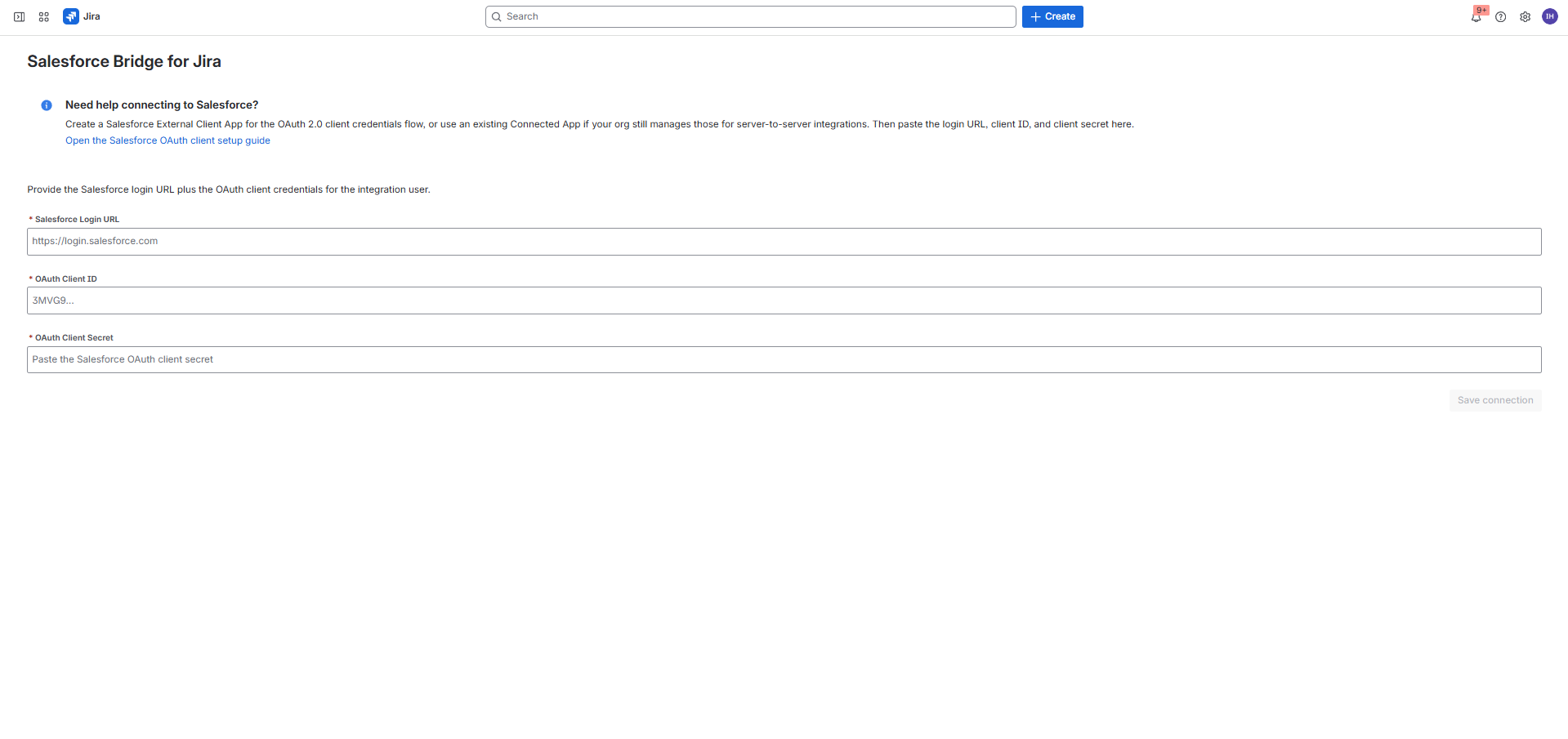
Use the same login URL family everywhere
If you choose a My Domain URL in Jira, keep using that same Salesforce hostname for your admin testing and direct record links. That reduces confusion when multiple Salesforce domains are in use.
Core Configuration
Create Smart Connected Items
Smart Connected Items are the core configuration unit for the Salesforce Bridge for Jira. The admin table mixes display-only items and synchronized items in one operational view so admins can review the Jira scope, Salesforce source, enabled sync features, and latest run status in one place.
| Column | Purpose |
|---|---|
| Name | The admin-facing Smart Connected Item name. |
| Sync Mode | Display-only, one-way sync, two-way sync, or Custom Sync per Mapping. |
| Jira Scope | One or more Jira projects for display-only items, or one project for synchronized items. |
| Issue Type | The Jira issue type used for synchronized items. Display-only items stay manual link only. |
| Salesforce Source | The selected module / object group and object. |
| Fields / Mappings | Selected preview fields or mapping summary, including custom field owners and conditional status notes where configured. |
| Auto Create / Comments / Attachments / Status / Association Display | Enabled or off indicators for the current row. |
| Latest Sync | Display-only state, waiting state, counts from the last run, or attention required. |
Display-only Mode
Use display-only items when Jira users only need record visibility
When display-only is the right fit
- You want users to manually link a Salesforce record from the issue panel.
- You only need a readable preview of selected Salesforce fields.
- You want to reuse the same object preview across multiple Jira projects.
- You do not want the scheduler or Jira events to modify either side.
How the admin flow works
- Enter a display name.
- Select one or more Jira projects.
- Select the Salesforce module / object group and object.
- Select the Salesforce fields to show in the issue panel after linking.
Preview fields are object-aware
The field picker reads live metadata from the selected Salesforce object. That keeps the preview list accurate for objects like Account, Contact, Lead, Case, and custom objects.
Synchronized Items
Create synchronized Smart Connected Items
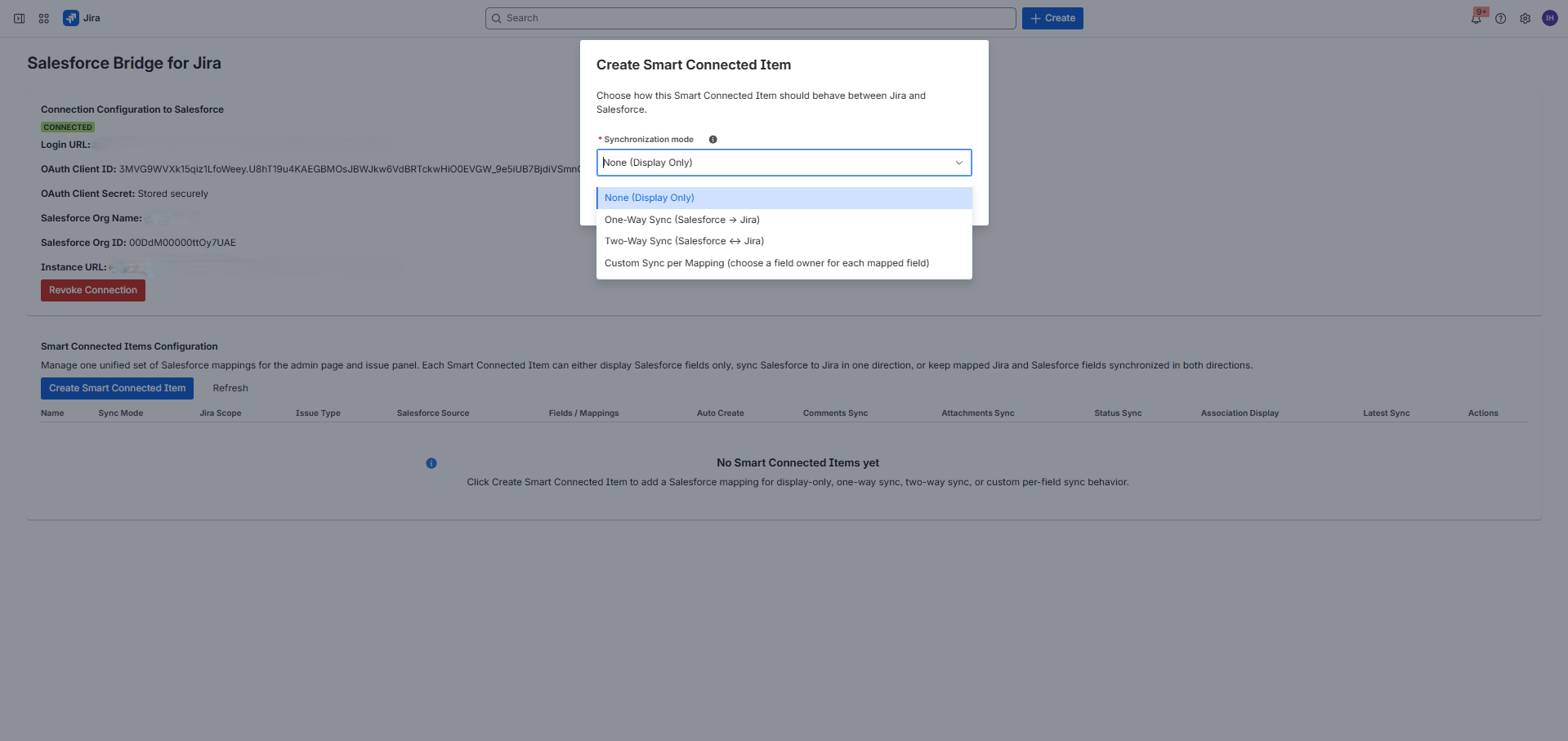
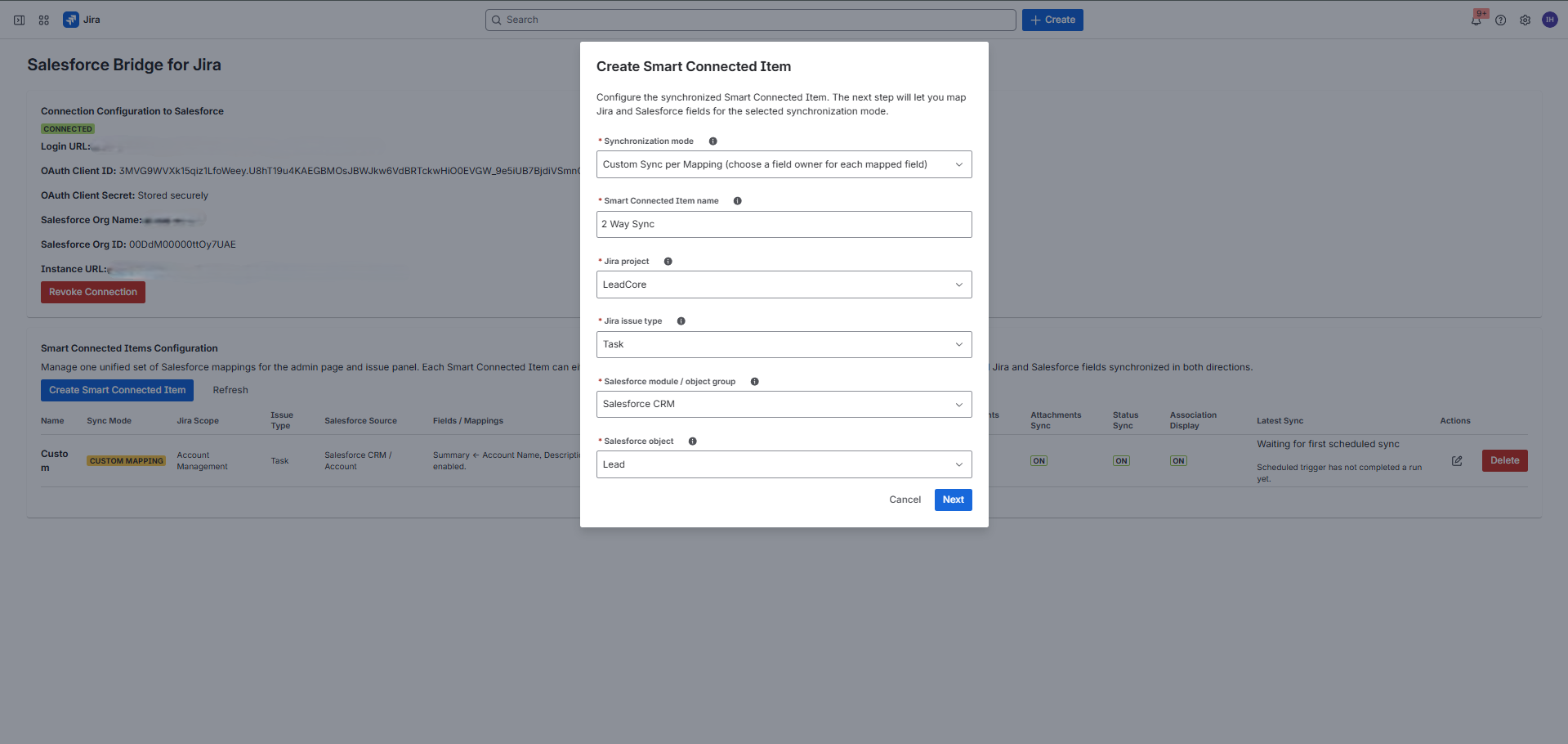
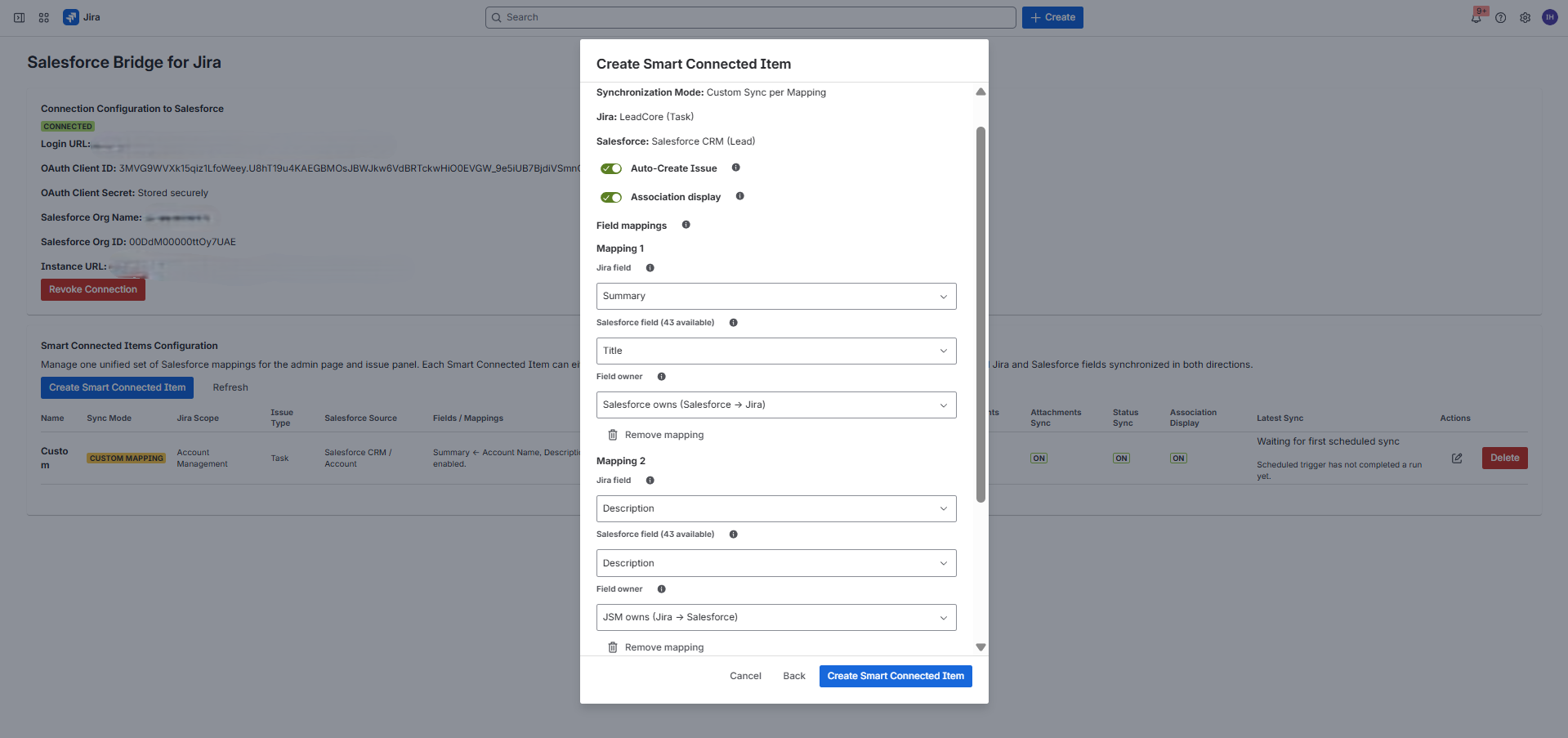
One-Way Sync (Salesforce -> Jira)
- Salesforce is the source of truth for mapped field values.
- The scheduler applies Salesforce changes to Jira every five minutes.
- Optional auto-create can open Jira issues from new Salesforce records.
- Comment, attachment, and status sync can still be enabled where appropriate.
Two-Way Sync (Salesforce <-> Jira)
- The scheduler still pulls Salesforce changes into Jira.
- Jira issue update events can push mapped field changes back to Salesforce.
- Jira comment and attachment events can also push to Salesforce when enabled.
- This mode is best when Jira teams actively work the issue and Salesforce must stay aligned.
Custom Sync per Mapping
- Each mapped field chooses its own owner instead of following one global direction.
- Salesforce owns writes Salesforce values into Jira for that mapping.
- JSM owns pushes Jira issue field changes into Salesforce for that mapping.
- Both own allows two-way behavior for the individual mapped field.
Associated records and conditional status
- Association display can show related Salesforce records below the primary linked record.
- Conditional Sync Rules can move Jira issues based on a selected Salesforce field value.
- These options are configured in the same second step as field mappings, status, comments, and attachments.
Auto-create requires a workable Jira issue type
If the selected Jira issue type requires fields that the bridge cannot map safely, the admin page shows warnings before save. Add the required mappings or choose an issue type with a compatible required-field set.
Status sync is intentionally independent from field direction
After the first successful link, status sync compares Jira and Salesforce timestamps and lets the most recent side win, even when field mappings are configured as one-way. First sync initializes from Salesforce so a brand-new Jira issue does not immediately overwrite the Salesforce status.
Behavior Matrix
Modes and behavior matrix
| Capability | Display Only | One-Way Sync | Two-Way Sync | Custom Sync per Mapping |
|---|---|---|---|---|
| Manual search and link from the issue panel | Yes | Yes | Yes | Yes |
| Scheduled auto-create Jira issue from Salesforce | No | Optional | Optional | Optional |
| Salesforce -> Jira mapped field sync | No | Yes | Yes | Per mapping when Salesforce owns or both own |
| Jira -> Salesforce mapped field sync | No | No | Yes | Per mapping when JSM owns or both own |
| Status sync when enabled | No | Yes, both directions | Yes, both directions | Yes, both directions |
| Comments sync when enabled | No | Yes, both directions | Yes, both directions | Yes, both directions |
| Attachments sync when enabled | No | Yes, both directions | Yes, both directions | Yes, both directions |
| Display associated Salesforce records in the issue panel | Optional | Optional | Optional | Optional |
| Conditional Sync Rules | No | Optional | Optional | Optional |
| Create Jira issue when condition is not met | No | Optional when auto-create is enabled | Optional when auto-create is enabled | Optional when auto-create is enabled |
Important behavior detail
Field mappings follow the selected one-way or two-way mode unless you choose Custom Sync per Mapping. In custom mode, each mapped field has its own owner and can move Salesforce -> Jira, Jira -> Salesforce, or both ways. Status, comments, and attachments use their own enabled or disabled switches.
Field Mapping Rules
Control sync direction per mapped field
How mappings work
A mapping pairs one Salesforce field with one Jira field. In one-way mode, the bridge only writes from Salesforce to Jira. In two-way mode, Jira issue update events can also push mapped Jira field changes back to Salesforce.
How custom field owners work
In Custom Sync per Mapping, each mapping includes a field owner. Choose Salesforce owns for Salesforce -> Jira, JSM owns for Jira -> Salesforce, or Both own for two-way synchronization on that one field.
When mappings are optional
You can create a synchronized Smart Connected Item with no field mappings when the goal is status-only synchronization, comment-only synchronization, attachment-only synchronization, associated record display, or manual linking without auto-create.
| Field owner | Direction | Typical use |
|---|---|---|
| Salesforce owns | Salesforce -> Jira | Use when Salesforce is the source of truth, such as account, contact, opportunity, or case data. |
| JSM owns | Jira -> Salesforce | Use when agents maintain the value in Jira Service Management and Salesforce should receive it. |
| Both own | Salesforce <-> Jira | Use only when the field is safe to update from either side and conflict behavior has been tested. |
Custom sync keeps one configuration simple
Custom Sync per Mapping avoids creating separate Smart Connected Items just because one Salesforce field should remain Salesforce-owned while another should be maintained by the Jira team.
Conditional Sync Rules
Control Jira creation and status from Salesforce field conditions
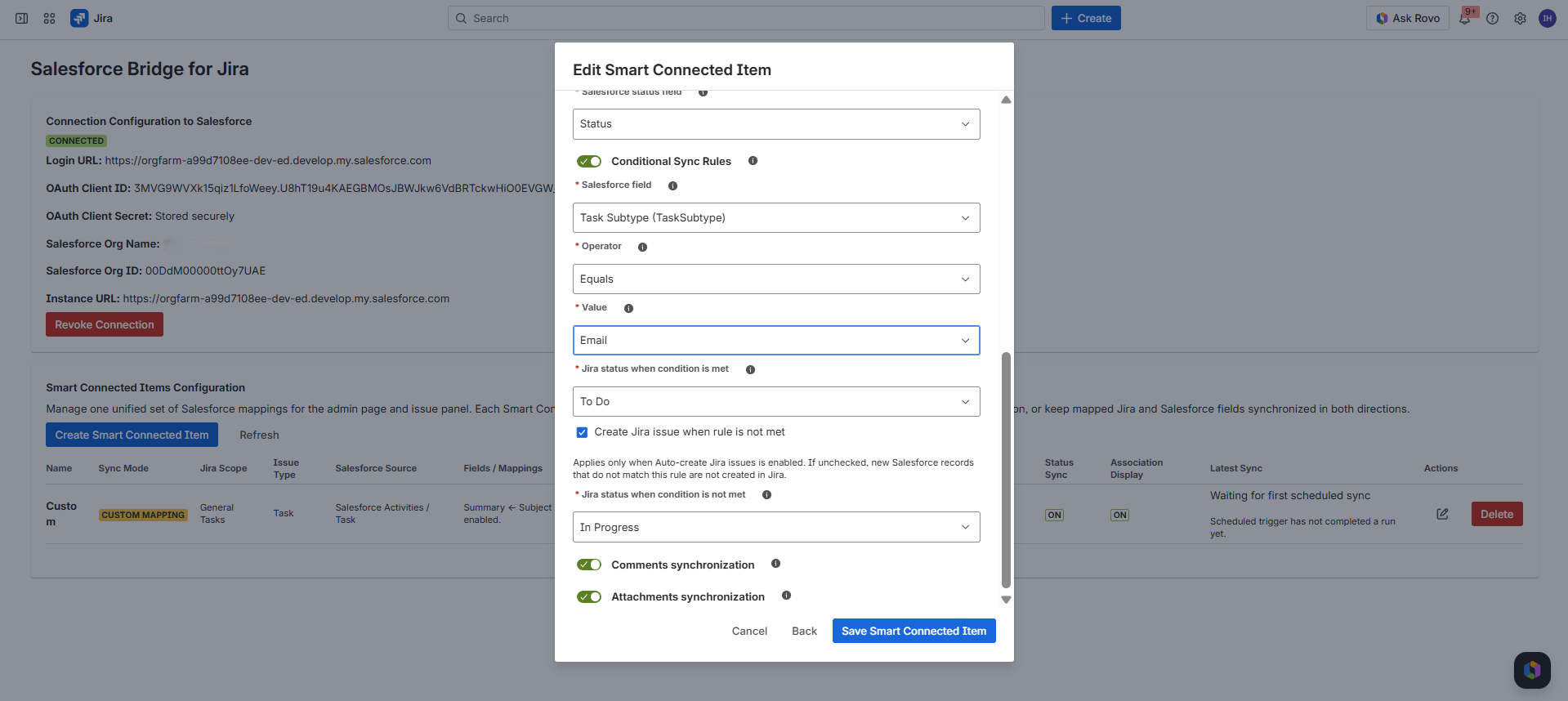
What the rule evaluates
A Conditional Sync Rule checks one Salesforce field on each eligible linked or newly discovered Salesforce record. The rule supports equality, inequality, empty, and not-empty checks. For picklist-like fields, the admin can select a Salesforce option value from the metadata-driven dropdown.
What happens when the rule is met
When a Salesforce record matches the configured condition, auto-create can create the Jira issue and the bridge uses the configured Jira status when condition is met. For already-linked records, scheduled sync and relevant link updates transition the Jira issue to that status when Jira exposes a valid workflow transition.
What the checkbox controls
Create Jira issue when condition is not met applies only when Auto-create Jira issues is enabled. When checked, new Salesforce records that do not match the rule can still create Jira issues and use the fallback status. When unchecked, those non-matching new Salesforce records are skipped by auto-create.
What happens when the rule is not met
The fallback Jira status still matters for records that are already linked, or for new records that are allowed through by the checkbox. In those cases, the bridge transitions the Jira issue to the configured Jira status when condition is not met when the workflow allows it.
| Configuration field | Meaning | Example |
|---|---|---|
| Salesforce field | The Salesforce field the bridge evaluates for the condition. | Account Rating (Rating) |
| Operator | The comparison rule: equals, does not equal, is empty, or is not empty. | Equals |
| Value | The expected value, unless the operator is empty or not empty. | Hot |
| Jira status when condition is met | The workflow status used when the Salesforce record satisfies the rule. | Done |
| Create Jira issue when condition is not met | Controls whether auto-create also creates Jira issues for new Salesforce records that fail the condition. | Checked |
| Jira status when condition is not met | The fallback workflow status used for already-linked non-matching records, and for auto-created non-matching records when the checkbox is checked. | In Progress |
How this interacts with other sync options
Conditional statuses take precedence over generic status synchronization for that Smart Connected Item. Field mappings still follow the selected sync mode or custom field owner settings. The checkbox only controls auto-creation for new non-matching Salesforce records; comments and attachments continue to follow their own enabled or disabled switches.
Auto-create must be enabled for the checkbox to matter
If Auto-create Jira issues is off, the checkbox does not create or skip Jira issues. It only changes how the scheduler handles newly discovered Salesforce records that fail the condition while auto-create is enabled.
Workflow transition requirement
Jira must expose a transition from the issue's current status to the configured target status. If the workflow does not allow that move, the bridge cannot force the issue into the selected status.
Associated Records
Display associated Salesforce records
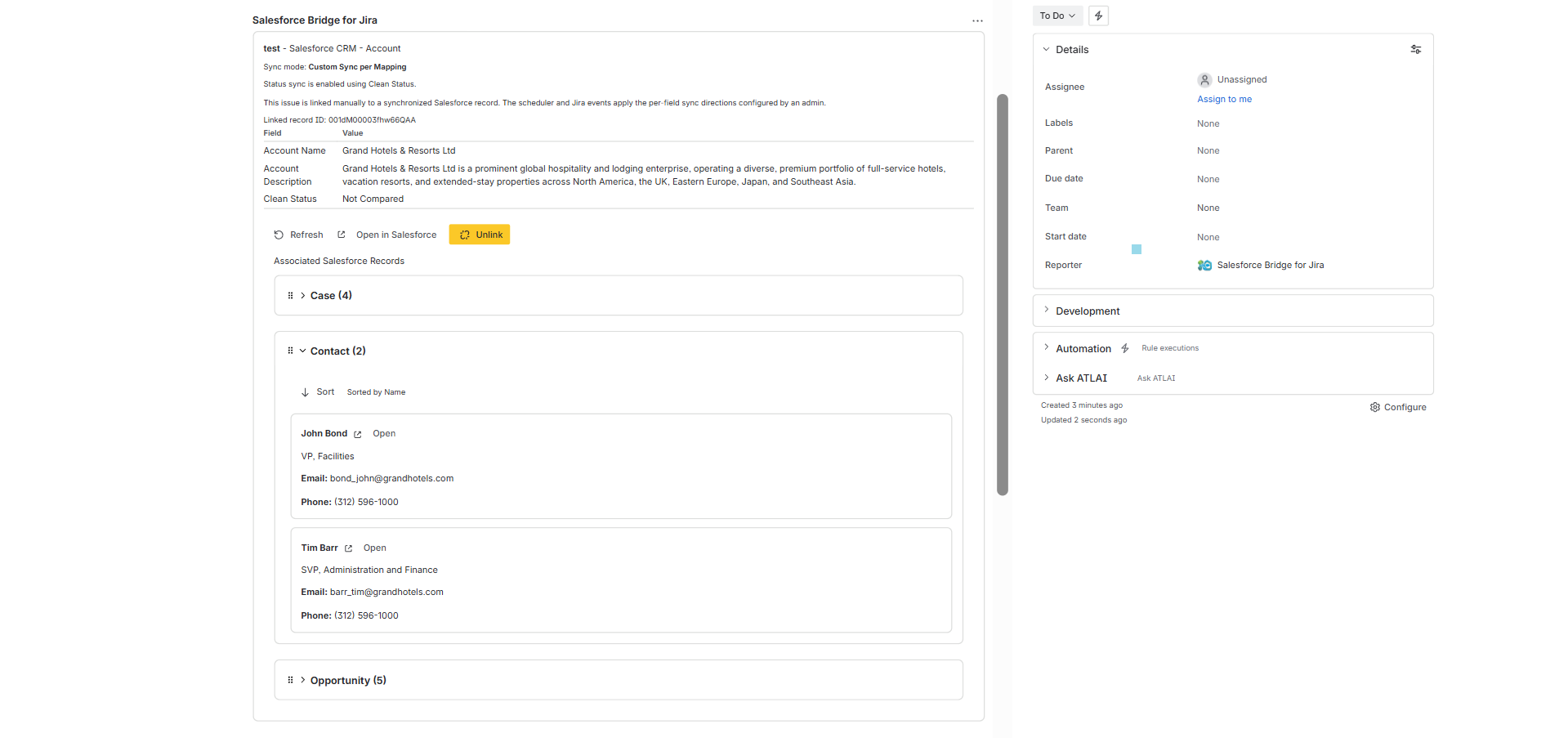
What the toggle does
When enabled, the Jira issue panel looks up Salesforce records related to the primary linked record and groups them by record type. Common examples include Cases, Contacts, Opportunities, Activities, and other records exposed by the selected Salesforce object and relationship metadata.
What users see
Users see expandable groups under Associated Salesforce Records. Each returned record shows a compact preview of useful fields and an Open action when the bridge can build a Salesforce URL for that related record.
Read-only context
Associated records are displayed for context. They do not create Jira links, do not become sync targets, and do not change the main linked Salesforce record. The primary linked record remains the only record controlled by the Smart Connected Item.
Performance boundary
The bridge limits association lookups so the Forge issue panel stays responsive. If a Salesforce object has many relationships, the panel prioritizes useful CRM relationship groups and stops before exceeding the runtime budget.
Permissions
Permissions and access reference
Forge-side access used by the app
storage:appread:jira-workwrite:jira-workread:jira-userread:issue:jirawrite:issue:jira
Salesforce-side access the Run As user needs
- API access.
- Read access to Salesforce describe metadata for target objects.
- Read and update access on the objects selected in Smart Connected Items.
- Read access to related objects that should appear in associated record groups.
- Access to comment and feed objects used by the selected record type.
- Access to Salesforce Files APIs for attachment synchronization.
External network egress stays Salesforce-scoped
The app egress configuration is limited to Salesforce login and instance domains such as
login.salesforce.com, test.salesforce.com,
*.salesforce.com, *.my.salesforce.com, and
*.force.com.
Jira User Guide
Use the Jira issue panel
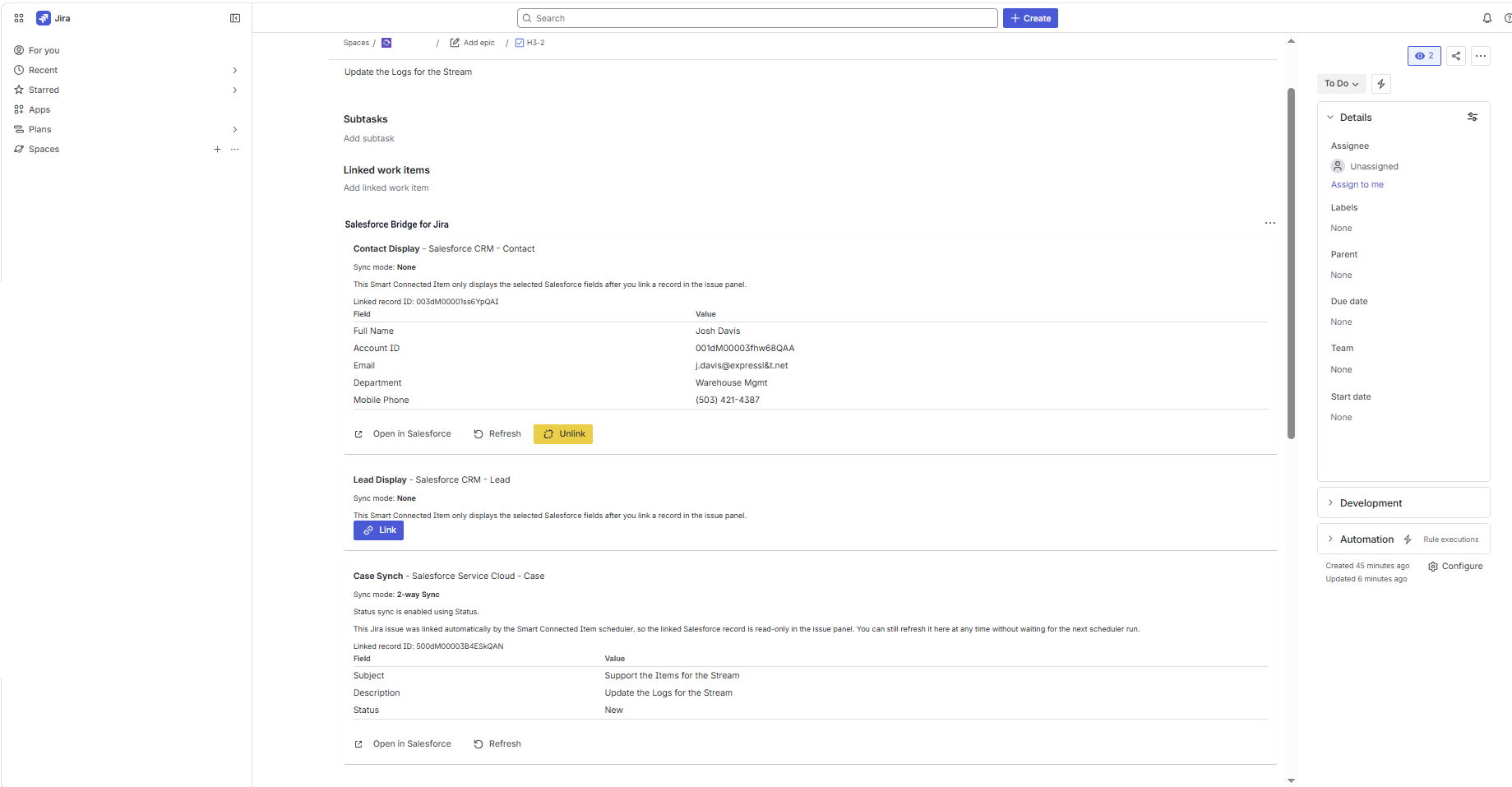
What each card shows
- The Smart Connected Item name plus the Salesforce module and object label.
- The current sync mode and status-sync context where applicable.
- The linked Salesforce record ID.
- A preview table containing the selected or mapped Salesforce fields.
- Open in Salesforce and Refresh actions.
- Unlink only for manual links.
- Associated Salesforce record groups when the admin enabled association display.
Record preview formatting
- Lookup search results adapt to the selected object's important fields.
- Cases typically display like
00001026 [Korvex Systems Sample Case Test]. - Other objects use the best identifier and descriptive fields available, such as
Name [Email]orContractNumber [Status]. - The issue panel preview itself uses the field names the admin selected in the configuration.
Associated record display
The associated records area is read-only. It helps Jira users understand surrounding Salesforce context without leaving the issue, while the main linked Salesforce record remains the record used for refresh, unlink, field synchronization, comments, attachments, and status behavior.
Manual Operations
Link, Refresh, and Unlink
Link a record
The modal title is Link a Salesforce record. Users can start typing to search Salesforce records or paste a direct 15- or 18-character Salesforce record ID.
Search behavior
Free-text search uses object-specific search fields such as Case Number, Subject, Name, Company, Email, Phone, or Website depending on the selected Salesforce object.
Refresh
Refresh forces the bridge to immediately pull the latest Salesforce fields, comments, and attachments into Jira instead of waiting for the next scheduled run.
Unlink
Only manual links can be unlinked in the issue panel. Auto-managed links remain protected so the scheduler continues to own the relationship safely.
Scheduler-owned Relationships
How auto-managed links behave
When links become auto-managed
- The five-minute scheduler finds a new Salesforce record that matches a synchronized item.
- Auto-create in Jira is enabled for that Smart Connected Item.
- The bridge creates the Jira issue and stores the link as scheduler-owned.
What Jira users can still do
- Open the linked Salesforce record.
- Refresh the record immediately.
- Read the mapped Salesforce preview fields.
- Work the Jira issue normally so mapped Jira changes can still flow back when enabled.
Why the panel stays read-only for auto-managed links
The scheduler uses the stored relationship to track comments, attachments, status state, and field sync history. Letting a user manually replace or remove that link would make the sync state ambiguous, so the bridge keeps the relationship protected in the issue panel.
Salesforce Effects
What changes in Salesforce after linking
Mapped fields
- In one-way sync, Salesforce remains the source of truth for mapped field values.
- In two-way sync, Jira issue update events can push mapped field changes back to the linked Salesforce record.
- In Custom Sync per Mapping, each field follows its own owner: Salesforce owns, JSM owns, or both own.
- The admin controls exactly which fields participate in synchronization.
Status behavior
- Status sync uses the chosen Salesforce status-like field and Jira workflow status.
- Conditional Sync Rules can override generic status sync for the configured Smart Connected Item.
- The bridge looks for the closest safe alternative instead of requiring identical workflows.
- For Cases, Jira-to-Salesforce close handling uses the supported incident close behavior instead of faking an unsafe generic patch.
Comments and feed replies
- Cases use
CaseCommentfor top-level comments. - Case feed replies are also read from
FeedItemandFeedComment. - Other feed-capable records use
FeedItemfor top-level notes andFeedCommentfor replies. - Reply threads are flattened into Jira comments because Jira comments do not preserve Salesforce feed threading one-to-one.
Attachments
- Salesforce Files are synchronized through
ContentVersion,ContentDocument, andContentDocumentLink. - Scheduled sync and manual refresh can pull Salesforce files into Jira.
- New Jira attachments are uploaded to Salesforce quickly through Jira attachment events.
- Existing paired files are not duplicated. Deletions are not mirrored automatically.
Traceability
Bridge-managed markers and notes
| Marker | Where it appears | Purpose |
|---|---|---|
| Salesforce Jira link note | Salesforce comment / note surface for the linked record | Stores the Jira issue key, URL, Smart Connected Item name, and whether the link is manual or automatic. |
[Salesforce Bridge for Jira] Jira attachment sync note |
Salesforce comment / note surface for Jira-origin attachments | Prevents duplicate file sync and records the Jira attachment ID plus the synced filename. |
[Salesforce Bridge for Jira] Attachment sync comment |
Jira issue comment timeline | Makes it clear when a synced attachment originated in Jira or in Salesforce. |
| Flattened reply sync note | Jira comments or Salesforce notes depending on direction | Preserves the parent-comment context when Salesforce feed replies are flattened during sync. |
Operations
Troubleshooting
The Jira admin page rejects the Salesforce credentials
Recheck the Login URL, Client ID, and Client Secret first. Then confirm the External Client App is configured for Client Credentials Flow and has a valid Run As user with API access.
- No client credentials user enabled: enable Client Credentials Flow and choose a Run As user.
- Too many scopes requested: keep only the minimal API scope the bridge needs.
- Scope parameter not supported: configure the app itself with the minimal API scope and retry.
Clicking New External Client App shows Page not found in Salesforce
Use a Salesforce Developer Edition org or another org where External Client Apps are available. Also confirm the current Salesforce user can manage apps in Setup.
The issue-panel lookup says No matching records found
Start with a short, real text fragment from the target object's key searchable fields. For Cases, that is often Case Number or Subject. For Accounts and Contacts, use Name, Email, Phone, Website, or another field the object exposes as searchable in the bridge.
You can also paste the direct Salesforce 15- or 18-character record ID to link it explicitly.
Status sync did not move the Salesforce record to the expected state
Confirm that status sync is enabled, that the selected Salesforce object exposes a usable status-like field, and that the integration user can update that field.
For Cases, remember that closed-state handling follows supported Case lifecycle logic rather than a raw generic status patch.
A Conditional Sync Rule did not move the Jira issue
Confirm the selected Salesforce field value really matches the configured operator and value. Then check whether the Jira workflow exposes a valid transition from the issue's current status to the configured target status.
Conditional Sync Rules take precedence over generic status sync for the Smart Connected Item, but they still depend on normal Jira workflow transition rules.
Auto-create skipped a Salesforce record that did not match the condition
Check whether Create Jira issue when condition is not met is enabled for the Smart Connected Item. If the checkbox is unchecked, the scheduler does not create Jira issues for newly discovered Salesforce records that fail the Conditional Sync Rule, even when Auto-create Jira issues is enabled.
Associated Salesforce records are missing from the issue panel
Confirm Association Display is enabled for the Smart Connected Item and that the Run As user can read the related Salesforce objects. If the selected Salesforce object exposes many relationships, the bridge may limit the result set to keep the Forge issue panel responsive.
A custom mapped field is not syncing in the expected direction
Check the field owner on that specific mapping. Salesforce owns writes Salesforce to Jira, JSM owns writes Jira to Salesforce, and Both own allows both directions for that field. Also confirm the integration user can update the target Salesforce field.
Attachment or comment sync is incomplete
Confirm the Smart Connected Item has the relevant sync option enabled and that the Run As user can access comments, feed items, feed comments, and Salesforce Files for the selected object.
The issue-panel Refresh action is the fastest way to force an immediate inbound pull while you validate the setup.
Known Limits
Current product limits and behavior boundaries
10 MB attachment ceiling
Files above 10 MB are skipped to stay inside Forge runtime and payload boundaries.
Reply flattening
Salesforce feed replies are flattened into Jira comments rather than preserved as threaded replies.
No delete mirroring
Deleted comments or deleted attachments are not automatically removed from the opposite system later.
Auto-managed links stay protected
Scheduler-created links are intentionally read-only in the issue panel.
Status sync depends on object metadata
If the selected Salesforce object does not expose a usable status-like field, status sync should remain disabled.
Conditional sync depends on workflow transitions
Conditional Sync Rules can only move a Jira issue when the current workflow exposes a valid transition to the configured target status.
Non-match auto-create is explicit
The bridge only auto-creates Jira issues for non-matching Salesforce records when Auto-create is enabled and the non-match checkbox is checked.
Associated records are read-only context
Associated Salesforce records do not become linked records, sync targets, or separate Jira issues.
Custom object availability depends on org metadata and access
Custom objects only appear when the connected Salesforce org returns them through describe metadata and the integration user can see them.
References
Official references
Salesforce: invoke REST APIs with the integration user and OAuth client credentials
Salesforce Developer Edition signup
Salesforce REST API developer guide
Salesforce object reference: Case
Salesforce object reference: FeedItem
Salesforce object reference: FeedComment
Salesforce object reference: ContentVersion
Atlassian Forge documentation